

Major report recommends safer drug laws to combat rising harms
A major new report proposes evidence-based reform to New Zealand’s drug laws in response to growing drug harm that the Drug Foundation says will worsen without action.
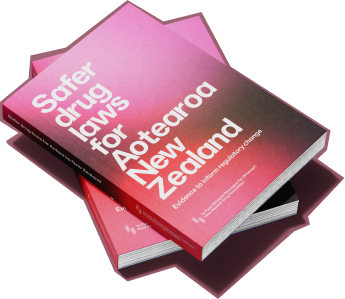
Safer drug laws for Aotearoa New Zealand, released by the Foundation at Parliament this morning on the 50th anniversary of the Misuse of Drugs Act 1975, examines the impact of New Zealand’s drug laws and the growing evidence of law reform efforts overseas.
Executive Director Sarah Helm says the law has been a major driver of harm while outlawing interventions that could help.
“The evidence shows that our drug laws have exacerbated addiction, overdose, deaths and criminalisation,” she says.
"In the past 12-18 months alone, we have seen methamphetamine and cocaine use double, new potent substances enter the drug supply, communities overrun with drug harm, and 3,000 New Zealanders criminalised for cannabis consumption.”
“Our drug laws are unsafe and the status quo is untenable – things are only going to get worse if we fail to act. We do not want to end up with the kinds of drug issues being seen in North America.”
“It is hard to see how any of the MPs who ushered in the Misuse of Drugs Act fifty years ago would consider what’s transpired since to be anything but a colossal failure,” Helm says.
The report paints a grim picture of the law’s impact:
- Drug-related deaths have risen steadily, reaching nearly three fatal overdoses every week in 2024
- Chronic harms such as substance use disorder have increased, with services under increasing strain
- The global illicit drug supply has become more volatile and toxic
- Māori have faced disproportionately severe impacts, accounting for more than half of those imprisoned for drug offences in 2023 and suffering a fatal overdose rate twice that of non-Māori
The report pulls together evidence from a wide range of law reform models and harm reduction interventions implemented internationally, including 34 countries and 36 sub-jurisdictions that have decriminalised cannabis use, and 22 countries that have decriminalised all drug use.
Helm says that after careful consideration of the evidence, decriminalisation of drug use, coupled with significant investment in health and harm reduction services, has the clearest evidence of success – offering a reduction in problematic use in particular.
“Portugal’s two decades of experience of decriminalisation is compelling,” she says.
“Overdose deaths fell dramatically, HIV transmission rates plummeted, and the burden on the criminal justice system was eased, all without an increase in drug use. Portugal now has one of the lowest rates of drug-related deaths in the EU.”
A poll commissioned by the Drug Foundation in 2022 found that 61% of New Zealanders supported ‘removing penalties for drug use and putting in place more support for education and treatment’. 68% supported ‘rewriting the Misuse of Drugs Act and putting in place a health-based approach’.
Helm says a big factor in Portugal’s success was that decriminalisation was coupled with substantial investment in health support and harm reduction.
“Our report is very clear that any law reform efforts must be coupled with significant investment in support, including ringfenced funding for services designed and delivered by Māori, who have experience the greatest harm from our current laws,” she says.
The report also recommends a new regulatory framework that would empower a health agency to licence harm reduction interventions (such as overdose prevention centres, safer utensils and more flexible drug checking).
"At the moment the law prevents us from implementing many life-saving overdose and harm reduction measures that would reduce social and health costs upstream. We shouldn’t have to go through a lengthy legislative process each time we want to put commonsense life-saving measures in place.”
“We need a responsive and flexible regime that gives an appropriate health agency the power to monitor the evidence and make decisions at arms-length, with clear goals to improve health outcomes.”
The report suggests that a similar framework could be used to enable future regulation of lower-risk substances where there is growing harm or new evidence.
It shows that regulated access to cannabis can work, but design matters.
“The evidence was clear that commercial models don't work,” says Helm. “They are successful at displacing the illicit market, but overall drive up health harms."
“Not-for-profit models implemented in Malta, Uruguay, and more recently Germany, have been shown to displace the illicit market without introducing some of the less desirable outcomes we’ve seen from more commercialised legal models in North America.”
“For other lower-risk substances, the evidence for regulated supply doesn’t yet exist, so we have stopped short of recommending this, but we recommend shifting to a more flexible legal framework that would allow us to assess emerging evidence on a case-by-case basis. What may seem out of the question now might change in the future with a rapidly changing illicit drug market, and having options to respond will be important.”
Helm says that no one has all the answers to drug harm, but the report pulls together the latest evidence of what has been shown to work.
“The reforms we suggest are not about liberalisation – in fact they offer the opposite: regulation, safety and control,” she says.
“We are realistic – we don’t expect these recommendations to be picked up from day one, but we hope that they help inform decision-makers and are the start of a conversation. Everyone can see that the status quo is completely untenable – we need to do things differently.
“We are really pleased to have the Cross-Party Mental Health and Addictions Wellbeing Group receiving the report today.”
The report was developed with the generous support of the Michael and Suzanne Borrin Foundation.
Read the full report
Safer drug laws for Aotearoa New Zealand: Evidence to inform regulatory change
Read the report
Recent news

Overdose deaths remain unacceptably high as stimulant harms increase
New Zealand is losing three people a week to preventable overdose, while hospitalisations from stimulants like methamphetamine and cocaine are increasing alongside a recent surge in consumption.
Report: Drug overdoses in Aotearoa 2026
Our annual report compiling coronial and hospitalisation data.

Election 2026: Where the parties stand on reducing drug harm
There is common ground among parties on reducing drug harms and supporting addiction treatment, suggesting progress can be made in the next term.