

Our drug laws are unsafe and things will get worse if we don’t change them.
The evidence shows they have been a major driver of harm while outlawing interventions that could help
Since the Misuse of Drugs Act became law in 1975:
- Tens of thousands of people have been imprisoned
- The global drug supply has become more unpredictable and toxic
- Overdose deaths have climbed, reaching almost three per week in 2024
- Chronic drug harms like substance use disorder have risen and services are under strain
- Māori have been disproportionately affected by drug harm and the criminal justice system
We can make our drug laws safer for everyone.
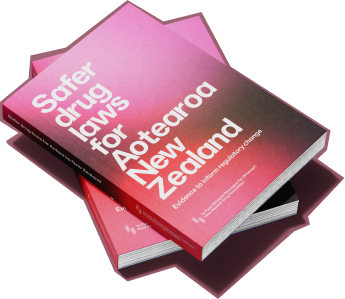
In our major new report, Safer drug laws for Aotearoa New Zealand: Evidence to inform regulatory change, we examine the impact of our drug laws over the last 50 years, the perspectives of New Zealanders who have directly experienced drug harm, and evidence from countries that have reformed their drug laws.
We then put forward a suite of well-evidenced, pragmatic approaches for a safer, more responsive law.
The reforms proposed are not about liberalisation – in fact they offer the opposite: regulation, safety and control.
Read the full report
Safer drug laws for Aotearoa New Zealand: Evidence to inform regulatory change
Read the report
Watch Sarah's speech
At the launch of our new report, Safer drug laws for Aotearoa: Evidence to inform regulatory change.
Chapter I (Misuse of Drugs Act 1975 in action) uses national data sources to examine drug use, harm and justice responses that have occurred under the Misuse of Drugs Act, including:
- prevalence of substance use
- health statistics (fatal overdose, poisonings, and substance use disorders)
- criminal justice measures (convictions and charges)
- illicit market measures (drug seizures, availability, and price)
- limited social indicators
Chapter II (Law Commission review of Misuse of Drugs Act 1975) reexamines the 2011 Law Commission review.
Chapter III (Achieving hauora: Aspirations of people affected by current drug laws) presents original research undertaken with communities at risk of drug harm in Aotearoa New Zealand, including a large survey and a series of workshops.
Chapter IV (Alternative options for drug control – lessons from other countries) presents an overview of evidence from jurisdictions that have attempted drug law reform and considers lessons for law reform in Aotearoa New Zealand.
Chapter V (Te Tiriti o Waitangi and drug law reform) discusses the impacts of the Misuse of Drugs Act on Māori and identifies lessons from other jurisdictions.
- Reduce social impacts of drug harm on all New Zealanders
- Reduce acute harms, such as overdose, and chronic harms, such as substance use disorder.
- Reduce the impact of criminalisation, especially among communities disproportionately affected by it, and reduce the scale and profits of the illicit market.
- Ensure people who use drugs can access health support and harm reduction information free from fear of prosecution, stigma, or discrimination.
- Enable appropriate access for all New Zealanders to therapeutic drugs that can benefit their health.
- Uphold te Tiriti o Waitangi and ensure Māori leadership and resourcing in policy development and service provision.
- Prioritise the health and social outcomes of regulation, and prevent excessive corporate influence on regulatory settings.
Donate to support safer drug laws
Together, we can transform the way Aotearoa addresses drug issues.
Donate nowRecommendations for safer drug laws
Aotearoa New Zealand’s current drug laws do not serve their intended purpose. Instead of protecting health, they entrench stigma, expose people to unsafe illicit markets, and perpetuate deep inequities, particularly for Māori. People who use drugs (and those who support them) have told us repeatedly how criminalisation prevents help-seeking, undermines hauora, and can disadvantage many aspects of their personal and professional lives. The impacts of criminalisation are stark: a criminal record for a drug offence, and the stigma associated with it, creates long-lasting barriers to critical components of everyday life – housing, jobs, and healthcare. If we continue with the status quo, we can expect drug harms such as addiction, overdose, and crime to increase.
These lived realities resonate strongly with international evidence, which shows that countries adopting health-based approaches achieve better outcomes than those persisting with punitive models. Whether in Portugal, Switzerland, Uruguay, or Canada, the evidence points in the same direction: shifting from punishment to health works. Together, these insights form a clear justification for replacing the MoDA with a new framework that prioritises health, equity, and te Tiriti o Waitangi.
Survey and workshop participants consistently told us that criminalisation led to a fear of prosecution when calling emergency services during an overdose, fear of lack of treatment when disclosing drug use to doctors, and the source of lifelong disadvantages in relation to housing and employment opportunities.
Systemic bias against Māori in particular was expressed, including disproportionate criminal justice system involvement. International evidence confirms that decriminalisation has positive impacts on a wide range of acute and chronic health harms, a reduction in criminal justice system involvement and costs, without increasing drug use. The evidence is clear that decriminalisation can mitigate some of the most harmful effects of punitive drug policies and allow more opportunities for health interventions to be provided. We recommend that Aotearoa New Zealand:
a. Decriminalise personal possession and use of drugs, including utensils.
b. Refocus enforcement away from policing use and possession offences and towards tackling supply and improving compliance with any new regulatory systems.
c. Ensure that any regulatory changes are accompanied by monitoring of health and social outcomes.
d. Put in place broad protections for people who seek help in the event of a drug overdose or acute substance harm, e.g., through Overdose Good Samaritan clauses.
e. Apply clean slate to previous possession/use offences.
f. Ensure pathways to regulated systems and away from illicit markets remain open for those impacted by criminalisation. This includes transition from illegal economy to legal supply.
g. Decriminalise cultivation of a small number of cannabis plants for personal use.
Communities we engaged with were clear: the focus on policing minor drug offences while critical health services remain underfunded was undesirable. Among Māori, the call was for kaupapa Māori approaches that empower whānau, hapū, and iwi to design and deliver their own solutions. International evidence shows that decriminalised jurisdictions increasing their investment in health, treatment and social services experience noticeable more positive outcomes than those that do not. We recommend that as well as decriminalisation, Aotearoa New Zealand should:
a. Substantially increase the provision of harm reduction, prevention, early intervention, and substance use disorder treatment services.
b. Increase access to specialist treatment interventions for people whose addiction drives their offending. These interventions must focus on reducing reoffending by addressing substance use disorder within the context of criminal behaviour, rather than relying on imprisonment.
People who have experienced drug harms voiced many frustrations with the legal constraints on interventions available to prevent many acute harms in Aotearoa New Zealand.
Notably, there were strong concerns around the risk of toxic adulteration of the illicit drug supply, with people feeling they had no other option but to access dangerous and unstable supply chains, risking serious health consequences. Other strong concerns were around a lack of legal protection when seeking health during an overdose event, the lack of a wide range of drug utensils, and the lack of safe places to consume drugs.
Overseas evidence is clear that interventions such as heroin-assisted treatment (Switzerland), safe-supply programmes and flexible prescribing practices (Canada), and drug consumption sites (Australia), could make a positive impact on the health and wellbeing of those who are at risk of acute drug harm.
Our legal settings need to be flexible in order to respond rapidly to acute or widespread drug harm events. We recommend that Aotearoa New Zealand:
a. Set clear goals to improve health outcomes and reduce drug harm in any new legislation.
b. Enable more harm reduction and overdose prevention measures immediately, such as DCS, safer utensils provisions, and a more diversified and flexible drug checking regime.
c. Ensure legislation enables ongoing adaptation and development of harm reduction and overdose prevention measures that are responsive to emerging risks and needs. Empower an appropriate health agency with discretionary powers and establish a rapidly responsive licensing system for harm reduction interventions.
d. Ensure legislation enables treatment and prescribing for people with substance dependence to evolve with changing drug supply issues, in line with international best clinical practice guidance, in all appropriate settings.
e. Enable professional facilitation of psychedelic assisted therapies, including beyond medicalised settings. Prioritise participant safety by putting in place strict product quality controls, and workforce regulation.
People told us that the current drug classification system did not protect them from the risk of drug harm. A shift was needed to protect people from toxic adulteration of the drug supply, by providing regulated access. At the same time, protecting those seeking to avoid or reduce drug use needed to be prioritised, as well as preventing the establishment of models that allowed for profiteering from a regulated market.
Internationally, jurisdictions such as Uruguay offer examples of non-profit, state-controlled cannabis regulation. The U.S. and Canada have adopted more commercialised models which appear to have been more effective at displacing the illicit market. This may have come at a cost of increased product potency, and higher rates of adult use. Evidence around regulating other substances is currently unavailable, except in jurisdictions that have authorised MDMA and psilocybin in clinical settings.
We propose that Aotearoa New Zealand adopts a more flexible drug classification system that takes into account a wide range of health outcomes, and can adapt to new evidence around harm or benefit of various substances. We recommend that Aotearoa New Zealand:
a. Replace the drug classification system with a more flexible legal framework that grants an appropriate health agency the power to review emerging evidence and strictly regulate lower-risk substances for adults on a case-by-case basis, based on expert advice. Expert advice must meaningfully include the contribution of people with lived experience and ensure the rights of Māori are upheld.
b. Regulate legal supply of cannabis through this framework via a non-commercial model, such as not-for-profit associations.
c. Utilise regulatory measures to limit harms of any regulated substance such as:
i. Age restrictions, price and potency controls, warning signs, and requirements to provide harm reduction and help information.
ii. Limits on product appeal and availability
iii. Bans or restrictions on advertising of products and suppliers
iv. Measures to prevent influence of commercial groups on public policy or messaging
d. Amend the Psychoactive Substances Act 2013 and harmonise it with the new regulatory regime.
Both Māori and non-Māori participants in our survey and workshops were clear that there needed to be better recognition of te Tiriti o Waitangi. Intergenerational harms caused by criminalisatio needed to be addressed by well-resourced kaupapa Māori services, under Māori leadership. In addition, Māori have a clear right to tino rangatiratanga over taonga species such as native fungi, which is currently prohibited under the MoDA. We recommend that Aotearoa New Zealand:
a. Ringfence part of the increased funding for harm reduction and substance use disorder treatment for Māori to empower and resource whānau, hapū and iwi to roll out appropriate interventions as they determine.
b. Ensure Māori are able to exercise tino rangatiratanga over taonga fungi that are currently listed as prohibited plants under the MoDA.