

On the frontlines of the methamphetamine surge

A sudden doubling of methamphetamine use since mid-2024 has seen under-funded community services struggling to respond. Madeleine Holden looks at what's behind the sudden surge, how communities are being affected, and what needs to change.
Methamphetamine use has spiked more than 300% in Waipukurau. Kaikohe is experiencing an ‘epidemic’. Auckland CBD has a ‘meth problem’, as does south Auckland, where use has doubled. Methamphetamine admissions are straining services in Waikato. Nationwide, consumption has doubled.
These are the headlines and soundbites about our national methamphetamine problem. The message is clear: New Zealand is in the grip of a crisis, set to worsen if things don’t change.
“The service is really, really busy,” says Richard Dick, director of the Salvation Army Bridge Programme for Northland, which provides support services for people impacted by alcohol and other drugs, including methamphetamine. “Our programmes are all full, our caseloads are high.”
But what is behind the rise in methamphetamine use? How are people and communities being impacted? And what is missing in our approach?
Wastewater drug testing data revealed that methamphetamine consumption increased dramatically in the past year: nationwide, it doubled from June 2024 to December 2024, and in badly affected towns in Hawke's Bay and Northland, use has tripled since 2023. Anecdotally, reports of people openly using and dealing methamphetamine in towns like Kaikohe and Rotorua are filling the nation’s newspapers, and frontline healthcare workers report a “tsunami of need” for addiction services.
Recently released figures for the first quarter of 2025 show that consumption has remained elevated.
Methamphetamine consumption (mg/day/1000 population) Jan 2019 - Mar 2025
View this in the New Zealand Drug Data sectionSarah Helm, Executive Director of the NZ Drug Foundation, says that while much of this increase is likely due to existing methamphetamine consumers increasing the frequency and amount they consume, the organisation is also hearing reports from the community of new people using methamphetamine.
According to Helm, the increase in consumption is being caused by a confluence of factors.
“There’s much more methamphetamine being produced internationally,” she says. The UN Office on Drugs and Crime reports that the production and trafficking of methamphetamine have risen sharply since 2021, with Customs and Police reporting record-breaking drug seizures at the border in the years since.
The large increase in methamphetamine flowing into the country may be one reason the price has dropped: the latest New Zealand Drug Trends Survey revealed that the average price of a gram declined by 36% from 2017/18 to 2024.
“A reduction in price and increase in availability is inevitably going to lead to people consuming more,” Helm says.
“It may also be that there have been changes in how organised crime is selling the product. This is something we don’t know much about, but it could be that we’re seeing the results of a more sophisticated approach.”
Helm says that the big increase in consumption has occurred alongside other social, employment, and housing issues, creating a “perfect storm”. “Methamphetamine suppresses feelings of hunger and cold,” she says.
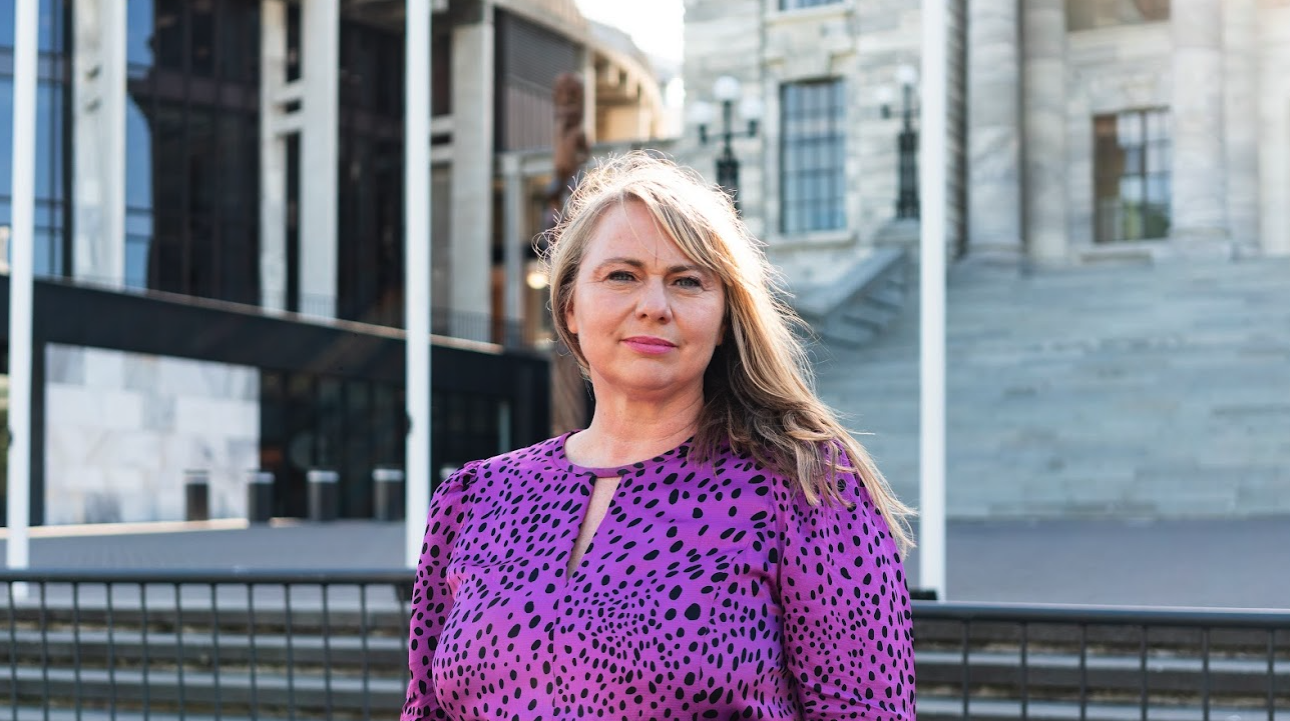
Sarah Helm, Executive Director of NZ Drug Foundation Te Puna Whakaiti Pāmamae Kai Whakapiri
Stephen King, director of the Alcohol and Drug Community Support Trust in Waikato, says the cost of living crisis fuels demand for drugs like methamphetamine. “Housing’s a problem, the cost of food’s a problem. Meth addiction, and addiction in general, is a form of escaping that reality. The trouble is, when you come down, the problem’s still there.”
There is also a relationship between drug use and widespread unmet health needs: as many as 50% of adults with ADHD will meet the criteria for substance use disorder at some point in their lifetime, international evidence compiled by the Drug Foundation shows.
Helm says the rapidly developing understanding of the relationship between untreated ADHD and methamphetamine use gives her hope that more could be done to prevent uptake, or to help people abstain or reduce their use.
“One Australian study found that 45% of people who regularly used illicit stimulants screened positive for ADHD, and other international literature is finding similar links,” she says. “If that is the case, we are hopeful that we could make a serious dent in methamphetamine harm by offering people treatment for their ADHD.”
Tricia Walsh, a Drug Foundation board member and a grandmother in Gisborne with previous experience of methamphetamine addiction, says the drug is a “huge contributor” to the East Coast region’s homelessness problem because of the cost of maintaining a habit. She sees a direct relationship between increased methamphetamine use and violence in the community, both domestic violence and “standovers” in the street, as well as the neglect of children.

Tricia Walsh, NZ Drug Foundation board member
“We’re seeing a lot more kids on the streets now because parents are absent,” Walsh says. “Some of our decile-one schools have close to half of their pupils being raised by grandparents.”
Dick says he frequently hears reports of people in Northland using a gram or more of methamphetamine a day. “That’s heavy use, and some people even more so.”
“As soon as you start using a gram or more a day, it will take you longer for your neurological changes to come right,” he continues. Other harms he sees associated with increased methamphetamine consumption include mood problems, sleep disturbances, housing issues, psychosis, and relationship problems – methamphetamine consumers have “often been cut off by their families,” Dick adds.
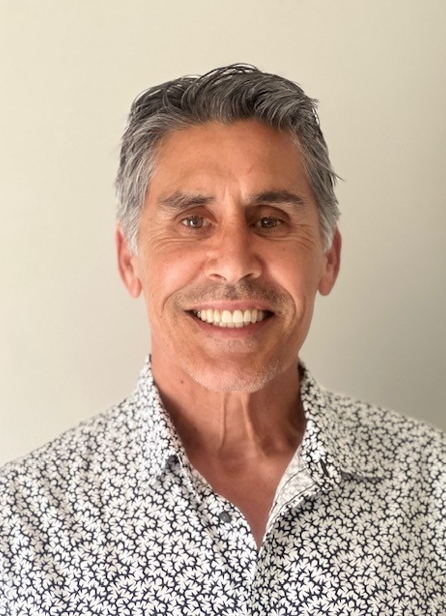
Richard Dick, Director of the Salvation Army Bridge Programme for Northland
The financial incentive to deal methamphetamine also helps bed the drug into communities, especially in regions with high unemployment, and dealing and use are not neatly separated, either: both King and Walsh mention that it is common for people who use methamphetamine to subsidise their habits by on-selling to others, often friends and family. “People are making a living off selling meth, so it’s really hard for them to see the social damage they’re inflicting on their own families,” Walsh says. “The money for them is just too much to let go of.”
The government has responded to the problem by forming a “meth harm sprint team”, a task force that includes the ministers of justice, police, customs and mental health. In late February, Customs Minister Casey Costello established a Ministerial Advisory Group on Transnational, Serious and Organised Crime which provides monthly reports to the minister regarding New Zealand's response to organised crime, including the import and distribution of drugs like methamphetamine.
In its March report, the advisory group likened New Zealand’s approach to “rearranging the deck chairs on the Titanic,” and said “it will take new ways of thinking, and bold changes, to alter the course for New Zealand.”
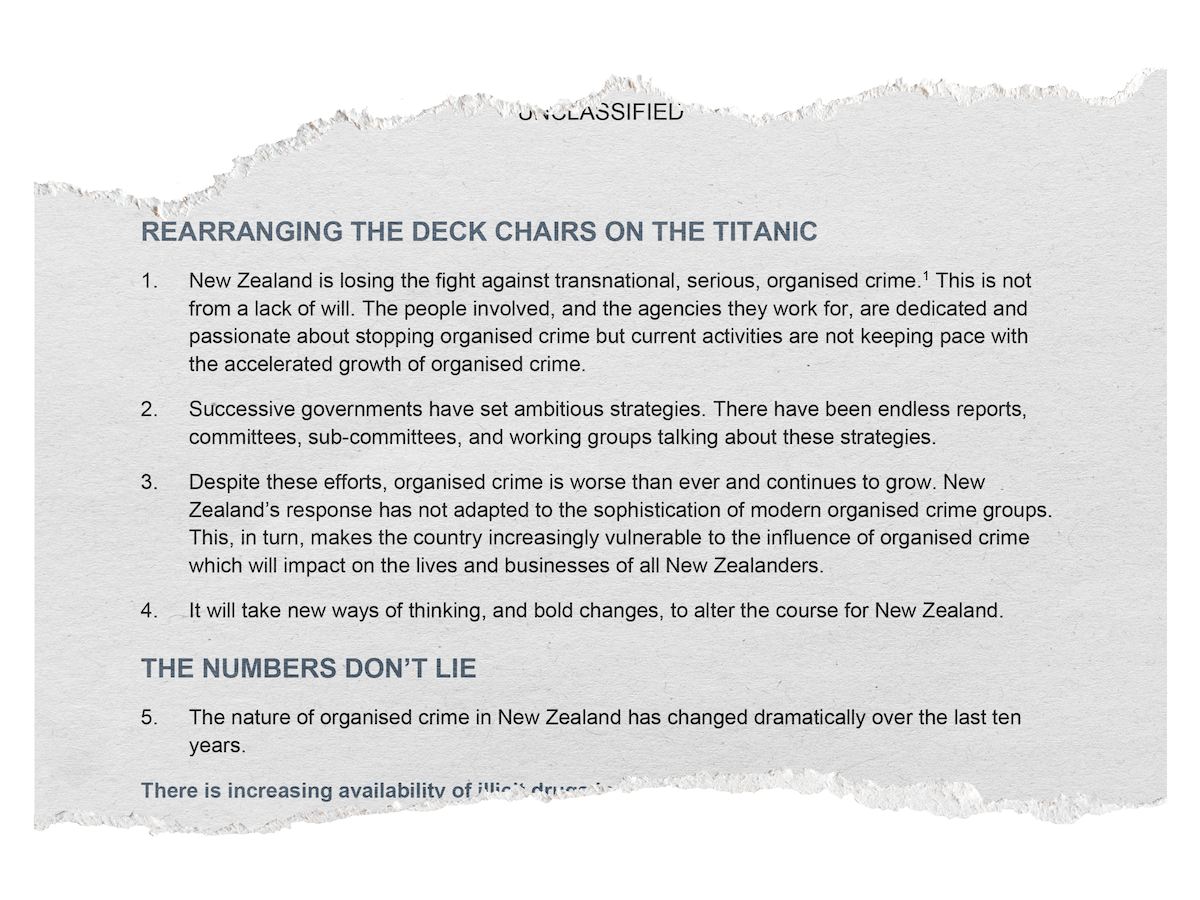
A section of a report from the Ministerial Advisory Group on Transnational, Serious and Organised Crime
So what can be done? “We can’t police – or even police and treat – our way out of our issues with methamphetamine,” Helm says. “We need to take a much more well-rounded approach.”
A report from Te Hiringa Mahara shows long-term underinvestment in addictions is taking its toll. In 2023/24, 5,000 fewer people were able to access help than in 2019/20. Of the total Mental Health and Addictions (MHA) budget, only 9.1% goes to addictions services, yet the addictions sector sees more than 25% of all MHA patients.
Helm says something has to give. “We need a much larger investment in addiction treatment and harm reduction. Help needs to be offered along the spectrum of use, and not wait until someone is experiencing problems,” she says. “But we also need to stop leaving people with long-term addiction to languish. Help needs to be readily available. Additional investment in mutual aid, intensive community-based programmes and kaupapa Māori services is also needed.”
Helm points to Te Ara Oranga, a methamphetamine harm reduction initiative involving Te Whatu Ora, NZ Police and community agencies, as just one example of an effective intervention that needs more support.
“We have been calling for an extension of Te Ara Oranga for a long time. At this point, it has been left to significantly dwindle. It needs a revamp, better inclusion of mana whenua, and an extension to other regions, particularly those most impacted by methamphetamine.”
Change in methamphetamine consumption per capita (mg/day/1000 people) by Police District (2024)
View this in the New Zealand Drug Data sectionIn areas where methamphetamine use is prevalent, locals – some with their own lived experience of addiction – are often left to develop their own responses or stretch beyond what they are funded to provide. In Gisborne, for example, Mauria Te Pono Trust offers a kaupapa Māori-based alcohol and drug recovery group; in Kaikohe, iwi organisation Te Hau Ora o Ngāpuhi helps link people impacted by methamphetamine with the help they need; and in Hamilton, King runs a supported accommodation service.
But these community-based solutions are often under-resourced, many frontline workers are unpaid or underpaid, and there is a shortage of healthcare professionals. “We would like to grow,” King says. “We have 30 beds and 20 bedrooms, but we’re only funded for nine beds. We could do so much more. We don’t have any counsellors except me and I’m a 0.5 [FTE]. We have three non-clinical support workers, and that’s it.”
Dick, who is also chairperson of the Te Ara Oranga steering group, echoes the call for more funding for beds and workers. “Even one more bed would help, and even one more FTE would help,” he says.
Walsh says communities also need to be resourced to educate rangitahi about drugs and take an “all-of-whanau approach” to supporting people who use drugs, their children, and other family members. “A lot of this is intergenerational transmission of trauma,” she adds.
Despite the scale of the problem and the difficulty finding resources to tackle it, Walsh says there is a lot of excellent work being done in communities like Gisborne to reduce drug harm.
“That’s where the hope lies: people haven’t given up,” she says. “Communities will keep fighting regardless. It just shouldn't have to be a fight.”
Featured image: Main Street New Zealand - Kaitaia, Northland, October 2007 by Phillip Capper (edited) under CC BY 2.0
Recent news

SMART Recovery funding to grow local peer-led addiction support in communities
Government money for mental health and addiction, announced today, will go straight into building local capacity to support people who want to address substance use.

Drug Foundation supports focus on early intervention in new govt strategy
The NZ Drug Foundation is pleased to see a focus on early intervention to reduce drug harm in the Government’s new mental health and wellbeing strategy
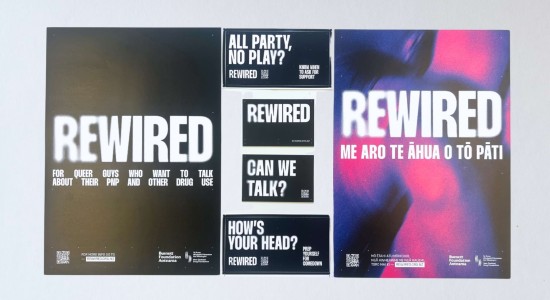
A peer-led model is the key to ReWired’s success
A recent evaluation of ReWired found the mutual-aid programme is outperforming international benchmarks.