

Report: Drug use in Aotearoa 2023/24

This report provides an overview of the most recent drug use data in Aotearoa New Zealand.
Its focus is on the prevalence of substance use and the patterns of drug consumption among different communities.
The data used in this report is primarily drawn from the New Zealand Health Survey (Ministry of Health) and from wastewater testing performed by the team at ESR for the National Drug Intelligence Bureau (NDIB). We also present data from the New Zealand Drug Trends Survey (Massey SHORE & Whariki).
We are very grateful to the teams that work tirelessly to collect, analyse and communicate the data.
Each data source has strengths and limitations associated with its particular methodology. These include:
The wastewater testing data used in this report relies on objective measures and is not influenced by societal views about substance use. However, wastewater testing is only able to quantify the total volume of drugs consumed in a particular catchment area, and it cannot provide us with information about patterns of use among people living there. For example, just based on wastewater data we cannot tell whether a larger volume of drugs detected in wastewater was associated with a larger number of people taking them, an increased concentration of the active substance in the available supply, or an increase in consumption by the same number of people. At times, a decrease in detection in wastewater may also be a cause of concern. When a preferred substance is less available in the illicit market, its consumers may be switching to a different substance whose risk profile is less known.
The wastewater testing data in this report is by calendar year and is the most recent data available at the time of producing this report.
Prevalence of use data (NZ Health Survey) is drawn from a large general population survey of New Zealanders and uses representative sampling. This allows us to gather information about substance use on a whole-population level. However, some substances are not widely used, which reduces the sample size and increases the risk of statistical errors. These errors are even more likely when looking at data among smaller demographic subgroups. This means that there may be significant year-toyear variation depending on recruitment in any given year. Because of this, comparing different groups of New Zealanders and trends over time needs to be done with caution. The Health Survey also relies on self-reporting of substance use. We know that substance use carries a level of stigma in Aotearoa, so it is possible that survey participants may be inclined to misrepresent their actual substance use.
The NZ Health Survey data presented in this report is by financial year, according to the survey methodology.
Drug pricing and availability data is sourced from the NZ Drug Trends Survey (NZDTS). The NZDTS is not a representative sample of the general population, as it specifically recruits people with experience with substance use. This means that while it’s not an appropriate method to draw conclusions for general population trends, it gives us detailed insights into what patterns of accessing and using substances are like among people who use them. This is also a self-reported survey.
The NZDTS data in this report is by either financial year or calendar year, according to the survey methodology for particular year.
Illicit drugs are used by people in every city, town and region of Aotearoa.
Cannabis is our most commonly used substance, and over half a million (675,000) adults* (15.6% of the population) used cannabis in the previous year. An estimated 225,000 people used cannabis at least once a week. Drugs such MDMA and opioids are used by a much smaller percentage of the population.
In 2023/24, 4.8% of the population aged 15 and over used MDMA (around 210,000 people), and 1.2% (around 51,000 people) used opioids.
The prevalence of cocaine use is relatively low, but is increasing. In 2023/24, 2.4% of adults aged 15 and over used cocaine (around 105,000 people), up from 1.3% last year. 2024 wastewater testing data has also revealed a sharp upward trend in cocaine consumption in every region compared with 2023.
The annual New Zealand Health Survey, which records the overall prevalence of illicit (nonprescribed) drug use in the past year, reported that a relatively low proportion (1.3%) of the population used amphetamine-type stimulants in 2023/24.
Recent wastewater testing, however, has shown a sharp increase in methamphetamine consumption in every region, especially in the second half of 2024. Because the NZ Health Survey did not capture data between July and December 2024, the two datasets we have used do not align exactly. This makes the interpretation of the findings more challenging. Further information about the strengths and limitations of the data we used is available in the closing section: ‘About the data’.
*The New Zealand Health Survey uses the term ‘adults’ to describe people aged 15 and over.
The large increase in methamphetamine detection in wastewater testing could be the result of an increase in the number of people using methamphetamine. The increase could also be attributed to increased volumes or frequency of methamphetamine consumption among current users, or a combination of these factors. The 2024 New Zealand Drug Trends Survey found that 29% of people who reported using methamphetamine in the past six months reported using it daily or near daily, compared with only 19% in 2022/23.1
The NZ Drug Trends Survey also found that substances such as cocaine and psychedelics are getting easier to obtain. It also reported that since 2017/18, the average prices of cannabis, methamphetamine, MDMA and psychedelics have fallen. Our report does not describe alcohol and tobacco consumption trends, instead focusing solely on illicit drugs. That said, alcohol continues to be New Zealand’s most frequently used substance, and 3.29 million adults reported having had a drink in the previous 12 months. A concerning number of those who drank in the past year (21%, or around 719,000) reported hazardous drinking.
People use alcohol and other drugs for many reasons.
These include pleasure and recreation, spiritual discovery, performance enhancement, experimentation, peer pressure, or to self-medicate physical problems, emotional pain or trauma.2,3
Drug use and drug harm are two different things.
Most people who use illicit substances will do so without encountering significant harm. However, some people will experience harm to their physical or mental health from substance use. These harms may be acute, such as drug overdose or acute psychosis, or long-term, such as impacts on cardiovascular or mental health.
Many drugs have health benefits when used in the right context.
Most of the substances covered in this report have established medicinal uses. Some – such as cannabis, amphetamines and opioids – can be prescribed by a doctor. Many others – such as psylocibincontaining mushrooms, LSD and MDMA – are being actively studied for their potential to treat a range of health conditions.4
Methamphetamine, MDMA and cocaine consumption per day/1000 people in 2024, compared to the previous three years’ average
Key changes in reported prevalence of drug use
From the NZ Health Survey
Prevalence of past-year drug use* among adults aged 15+ years5
Change between 2022/23 and 2023/24
|
15.6% – |
4.8% ↑ |
3.1% – |
|
2.4% ↑ |
1.3% – |
1.2% ↑ |


*The NZ Health Survey data does not include prescription drugs if the survey respondent used them as prescribed.
†The NZ Health Survey data on amphetamine use has a lag compared to the wastewater testing data we use in this report. This means that self-reported data on prevalence of use is unavailable for the final six months of 2024 – the period with the sharpest increase in methamphetamine consumption detected in wastewater testing.
Prevalence of adult (15+ years) past-year use of all drugs over time*
How we compare to Australia
Illicit drug markets in Australia and Aotearoa share many similarities, which results in similar patterns of drug consumption. But there are some differences.
For example, in 2022/23, a higher proportion of New Zealanders consumed amphetamines, cannabis, ecstasy and psychedelics, but more Australians consumed cocaine and opioids, according to the latest Australian data.5,7
Prevalence of past-year drug use in 2022/23 – comparison between New Zealand and Australia*
Factors affecting substance use
Substance use is affected by social and demographic factors, such as economic status, disability, ethnicity, age and gender.5 Below are some examples of these differences.
Gender
Men are significantly more likely than women to report past-year use of amphetamines/methamphetamine (2.17 times more common among men than women), cannabis (1.74), cocaine (2.76), MDMA (1.81) and opioids (1.76).
Age
Most illicit drug use declines as people age. However, past-year cannabis use has increased across all age groups in the past decade. The increase has been largest among those aged over 55 years. 12.3% of 55–64-yearolds now report past-year cannabis use, which is a 173% increase since 2013/14.
Economic status
People who live in the most deprived neighbourhoods are 3.22 times more likely to report at-least-weekly use of cannabis, compared to those who live in the wealthiest areas.
Women who live in the most deprived neighbourhoods are 10.33 times more likely to report past-year use of amphetamines/methamphetamine, compared to women who live in our wealthiest areas.
Ethnicity
Māori report the highest rates of past-year cannabis use (33.4%) and at-least-weekly cannabis use (13.3%) of all ethnic groups.
Māori are 2.83 times more likely to report past-year cocaine use compared with non-Māori.
Māori are 2.19 times more likely to report past-year use of amphetamines/methamphetamine compared with other ethnicities.
Disability
Disabled people are 2.78 times more likely to have used cannabis at least weekly. They are also 1.92 times more likely to report past-year cannabis use. Disabled people are also more likely to report past-year opioid use compared with non-disabled people (4.55 times), past-year use of amphetamines/methamphetamine (3.73 times), as well as past-year psychedelic use (2.71 times).
Price and availability
The price and availability of drugs can play a part in consumption patterns. Overall, the price of five of the most commonly used drugs has fallen between 2017/18 and 2024.1,8-11
Changes in price of selected illicit drugs between 2017/18 and 2024.1,8-11
|
$329 per ounce ↓ |
$221 per gram ↓ |
$29 per tab ↓ |
|
$360 per gram ↓ |
71% of cocaine consumers say the price is stable or decreasing* ↘ |
|

*While we don’t have cocaine price data, 71% of cocaine consumers thought that its price was stable or decreasing in 2024, compared to 63% in 2017/18.
Aotearoa at a glance
By Police District - 2024
The figures in the map relating to ease of availability, prices and use by region are obtained from the NZ Drug Trends Survey conducted by Massey University’s SHORE & Whariki Research Centre. The NZDTS surveys a very large number of people with recent experience and knowledge of drug use and drug markets across the country. While the NZDTS is not a representative sample, it broadly reflects the demographic profile and regional population distribution of New Zealand.
Figures relating to per capita drug consumption (mg/day/1000 people) were obtained from the national wastewater testing programme conducted by the National Drug Intelligence Bureau.
Wastewater testing data is organised according to ten Police Districts. The map mainly categorises data according to these Districts, which are: Northland, Tāmaki Makaurau, Bay of Plenty, Waikato, Eastern, Central, Wellington, Tasman, Canterbury and Southern. The exception is Tāmaki Makaurau, which includes the three Police Districts of Auckland City, Counties Manukau and Waitematā. NZ Drug Trends Survey data does not match Police Districts (for example, Otago, Taranaki, Manawatū-Whanganui), and where relevant, this is noted in the specific fact for that area.
Sources: (1, 6, 8–11).
Northland
- Lowest MDMA consumption per capita (average 131mg/day/1000 people)
- Highest methamphetamine consumption per capita (average 1488mg/day/1000 people)
Tāmaki Makaurau
- Highest cocaine consumption per capita (average 259mg/day/1000 people)
- Cocaine was most commonly reported as easy or very easy to obtain, compared with other urban centres and regions
Waikato
- Second-highest methamphetamine consumption per capita (1400mg/day/1000 people)
- Lowest-equal price of cannabis, along with Bay of Plenty (average $299/ounce)
Bay of Plenty
- Lowest-equal price of cannabis, along with Waikato (average $299/ounce)
- Second-highest cocaine consumption per capita (average 133mg/day/1000 people)
Central
- Second-lowest MDMA consumption per capita (average 173mg/day/1000 people)
- Lowest-equal price of cannabis in Taranaki (average $299/ounce)
Eastern
- Third-highest methamphetamine consumption per capita (average 1383mg/day/1000 people)
- Third-equal highest price of LSD tab in Gisborne and Hawke’s Bay areas (average $35)
Wellington
- 65% of psychedelic users reported that psychedelics were easily available
- Second-lowest average price per gram of MDMA ($216/gram)
Tasman
- Lowest cocaine consumption per capita (average 20mg/day/1000 people)
- Highest-equal price per gram of MDMA along with Otago (Southern) (average $244)
Canterbury
- Lowest average price per gram of MDMA ($213)
- Lowest-equal average price for a point (0.1g) of methamphetamine ($71) along with Tāmaki Makaurau
- Lowest average price for an LSD tab ($25)
Southern
- Highest MDMA consumption per capita (average 468mg/day/1000 people)
- Lowest methamphetamine consumption per capita (average 347mg/day/1000 people)
- Highest price for a gram of MDMA (average $244), a gram of methamphetamine (average $496), and an ounce of cannabis (average $361)
Cannabis
Cannabis use has risen among Māori and European New Zealanders.
More than a third (33.4%) of Māori now report past-year cannabis use. This is the highest prevalence in the past ten years, and a significant increase since 2013/14 (23.7%).5
Prevalence of past-year cannabis use by ethnicity*
*In 2020/21 there was a change to the way the question on drug use was asked in the NZ Health Survey. The Ministry of Health advises caution when comparing results from before 2020/21 with results from 2020/21 and after.
† Prevalence of cannabis use by Asian people should be interpreted with caution as the data has an RSE (relative sampling error; the size of the sampling error relative to the result) over 30%.
More than one in ten (13.3%) Māori also report at-least-weekly cannabis use. This is compared with 5.5% of European people, 5.1% of Pacific people and 0.7% of Asian people.
Wāhine Māori are 3.76 times more likely to report at-least-weekly cannabis use compared with non-Māori women. Tāne Māori are 2.92 times more likely to report at-least-weekly cannabis use compared with non-Māori men.
Cannabis use by ethnicity (2023/24)
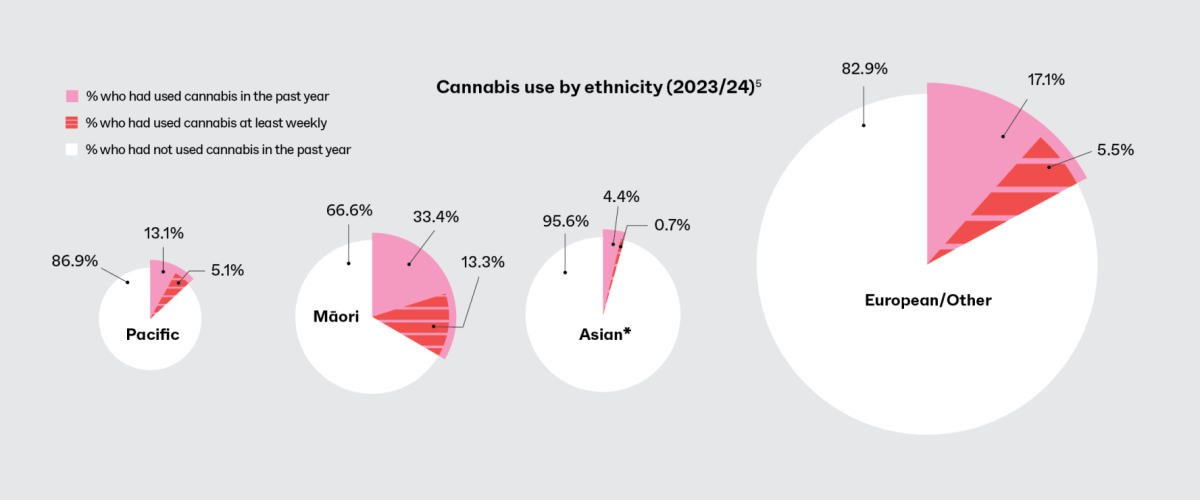
*Figures for Asian people for at least-weekly cannabis use may have a high sampling error. Caution is advised when interpreting these figures.5
At-least-weekly cannabis use is more common among disabled people, and those living in more deprived neighbourhoods.
Disabled people are 2.78 times more likely to report at-least-weekly cannabis use than non-disabled people.
Those who live in the most deprived neighbourhoods are 3.22 times more likely to report at-least-weekly cannabis use than those in the least deprived neighbourhoods.5
MDMA
MDMA use remains steady, and it is more commonly used by younger people.
New Zealand’s second most-commonly used illicit drug after cannabis is MDMA (sometimes referred to as ecstasy). 4.8% of adults reported past-year use, compared with 3.6% in 2022/23.5
Prevalence of past-year MDMA use (total and by gender)
Wastewater testing has shown that rates of MDMA consumption per capita have risen only slightly (2%) compared with the last three years’ average, to 259mg/day/1000 people. Every region except Tāmaki Makaurau and Eastern saw a decrease in consumption per capita.
Every year since 2018 (when wastewater testing for drugs began), the region with the highest MDMA consumption per capita has been the Southern region. However, in 2024 MDMA use decreased by 12% to 468mg/day/1000 people.
The region with the second highest rates of consumption in 2024 was Canterbury (304mg/day/1000 people). The Tasman region also had higher than average rates in 2024 (279mg/day/1000 people).6
MDMA consumption by Police District (average mg/day/1000 people)
MDMA use is far more prevalent among younger people than in older age groups. 10.5% of those aged 15–24 reported using it last year, which is an increase from 8.2% in 2022/23. Prevalence of MDMA use tends to decline in the 35-and-over age groups.5

Psychedelics
Psychedelics (or hallucinogens)* include substances such as LSD, psilocybin (found in certain mushrooms) and ketamine.
As a group, psychedelics are the third most-commonly used drugs in Aotearoa, after cannabis and MDMA. In 2023/24 3.1% of adults (around 134,000 people) reported taking psychedelics in the past year, compared with 1.3% in 2017/18.5
*The New Zealand Health Survey uses the term ‘hallucinogens’ to describe this class of drugs.
Prevalence of psychedelic use over time (total and by gender)*
*In 2020/21 there was a change to the way the question on drug use was asked in the NZ Health Survey. The Ministry of Health advises caution when comparing results from before 2020/21 with results from 2020/21 and after.
According to the NZ Drug Trends Survey, 62% of psychedelic consumers now report that LSD is ‘easy’ or ‘very easy’ to obtain, compared with 44% in 2017/18.10
Over the last decade, both men and women reported taking psychedelics at increased rates. Men are 2.01 times more likely to report psychedelic use than women. 4.1% of men and 1.9% of women reported taking psychedelics in the past year.
Māori are 1.57 times more likely to report past-year psychedelic use compared with non-Māori.
There has been a significant rise in psychedelic use by European New Zealanders, with 3.8% now reporting past-year use compared with 2.2% in 2018/19.
Disabled people are 2.71 times more likely to report past-year psychedelic use than non-disabled people.5
Prevalence of past-year psychedelic use by ethnicity (2023/24)
*Prevalence of psychedelic use by Pacific and Asian people should be interpreted with caution as the data has an RSE (relative sampling error; the size of the sampling error relative to the result) over 30%.
Cocaine
Cocaine consumption has increased significantly, with the biggest increases in some of our more rural regions.
Wastewater testing reveals that the total amount of cocaine consumed in Aotearoa has almost doubled in the past year.
In 2024 4.1kg of cocaine was consumed per week on average, compared to 2.1kg of cocaine consumed weekly in 2023. This figure was much lower in previous years, with just 1.0kg per week consumed in 2019.6
Prevalence of cocaine use in Aotearoa is increasing. It also appears that those who reported using cocaine in the past year have found it easier to obtain, and they are possibly consuming larger amounts.
The price of cocaine seems to be stable, according to its consumers.5,6,9
Prevalence of cocaine use (total and by gender)*
*In 2020/21 there was a change to the way the question on drug use was asked in the NZ Health Survey. The Ministry of Health advises caution when comparing results from before 2020/21 with results from 2020/21 and after.
†Data on prevalence of cocaine use among women should be interpreted with caution, as half of the data points have an RSE (relative sampling error; the size of the sampling error relative to the result) over 30%.
Wastewater testing reveals that in 2024 cocaine consumption per capita increased to 154mg/day/1000 people, up from a low baseline of 42mg/day/1000 people in 2019 (the first full year that testing was conducted). Cocaine consumption has doubled in eight out of ten regions between 2023 and 2024. The biggest increases in consumption since 2023 have been in some of our less-populated regions: Northland (184%), Eastern (176%) and Central (157%).6
Cocaine consumption per capita by Police District over time (average mg/day/1000 people)
The NZ Health Survey found that 2.4% of adults (105,000 people) reported using cocaine at least once in the past year, compared to 1.3% in 2022/23. Cocaine use has increased among people of every age since 2022/23, and significantly increased among those aged 35–44, from 1.3% to 4.1%.5,9
Past-year cocaine use is much more common among men (3.6%) than among women (1.3%). Māori and European New Zealanders have been reporting increased use of cocaine. These rates have increased to 5.8% (from 2%) among Māori, and 2.9% (from 1.5%) among Europeans between 2022/23 and 2023/24.
Overall, Māori are 2.83 times more likely to report past-year cocaine use than other ethnicities. There is higher reported prevalence of cocaine use among Māori men (9.4%) than men of any other ethnicity. 5.3% of people aged 25–34 reported using cocaine in the past year, the highest prevalence compared with other age groups.
Disabled adults are 1.92 times more likely to report past-year cocaine use than non-disabled adults.5
According to the NZ Drug Trends Survey, out of people who said they used cocaine, 29% reported using it monthly or more often in 2024, compared with 22% in 2017/18.
24% of NZ Drug Trends Survey respondents in 2024 said that cocaine is becoming easier to obtain, compared with 6% in 2017/18. 45% of people who use cocaine reported that its availability is stable, compared with 27% in 2017/18.
62% of people who use cocaine say that its price is stable, compared with 56% in 2022/23.9
Customs seizures of cocaine have been relatively higher in the last three years.
However, the numbers tend to fluctuate year-by-year, and are highly influenced by one-off events. For example, in 2023 a record 3.8 tonnes was seized, with the majority (3.2 tonnes) intercepted at sea in a single operation.12 In 2024 a much smaller volume of 466.8kg of cocaine was seized at our borders.13
Prevalence (%) of cocaine use by ethnicity (2023/24)
Amphetamines, including methamphetamine
In 2024 there was a sharp increase in methamphetamine consumption detected in wastewater testing, coupled with an average decrease in price.
In 2023/24 the NZ Health Survey found that past-year use of amphetamines has increased only very slightly compared to the previous year (from 1.2% to 1.3%), about 56,000 people.
It’s important to note that the NZ Health Survey data on amphetamine use has a lag compared to the wastewater testing data we use in this report. This means that self-reported data on prevalence of use is unavailable for the final six months of 2024 – the period with the sharpest increase in methamphetamine consumption detected in wastewater testing.
Prevalence of amphetamine use (total and by gender) over time
The increase in methamphetamine detected in wastewater testing could be a result of more people using it, or it could be caused by people using it more often. Or, it could be a combination of these factors.
According to the Drug Trends Survey, in 2024 29% of people who reported using methamphetamine in the past six months reported using it daily or near daily, compared with a much smaller proportion of 19% in 2022/23.1
Methamphetamine consumption has increased substantially in every region in 2024
Northland had the highest rate of methamphetamine consumption per capita (1,488mg/day/1000 people), and the largest increase in consumption since 2023 (148%). The Southern district remains the area with the lowest rate of use per capita, yet in 2024 there was still a 116% increase in consumption compared to 2023 (to 347mg/day/1000 people).6
Methamphetamine consumption per capita by Police District over time (average mg/day/1000 people)
Sharp increases in the second half of 2024
Consumption per capita rose in the second half of 2024 compared with the first six months, from 675mg/day/1000 people in January to June 2024, to 1303mg/day/1000 people in July to December 2024.
Change in methamphetamine consumption per capita (mg/day/1000 people) by Police District (2024)6
Tāne Māori and wāhine Māori are, respectively, 2.16 times and 2.86 times more likely to report amphetamine use than non-Māori men and non-Māori women.
The latest data shows that disabled people are 3.73 times more likely to report amphetamine use than non-disabled people.
Also, women who live in the most deprived neighbourhoods are 10.33 times more likely to report past-year amphetamine use than women living in the least deprived areas.
Prevalence (%) of amphetamine use by ethnicity (2023/24)
Opioids
The prevalence of reported past-year opioid use (including drugs such as heroin, morphine, methadone and codeine) has remained fairly low over the past decade.
However, prevalence did increase slightly in 2023/24 to 1.2% (around 51,000 adults) after falling to 0.4% in 2022/23.5 The relatively low prevalence of opioid use means that there can be large variation in the numbers year-to-year. This means caution is required when interpreting these figures.
Prevalence of opioid use (total and by gender) over time
*In 2020/21 there was a change to the way the question on drug use was asked in the NZ Health Survey. The Ministry of Health advises caution when comparing results from before 2020/21 with results from 2020/21 and after.
†Prevalence of opioid use by men should be interpreted with caution as some data points have an RSE (relative sampling error; the size of the sampling error relative to the result) over 30%.
Even people who use non-opioid drugs can be at risk of opioid overdose.
Some illicit drugs (for example, stimulants, synthetic cannabinoids) can be adulterated with ultra-potent opioids such as fentanyl and nitazenes, which people might not be aware of when they obtain them.
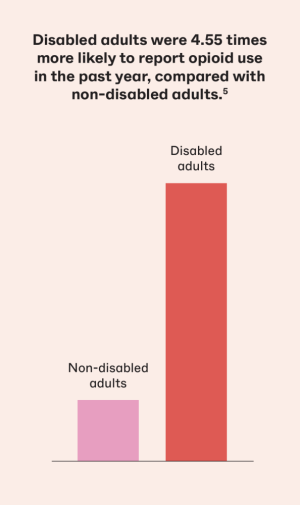
Prevalence of opioid use is higher among Māori than among European, Pacific or Asian New Zealanders.
Prevalence (%) of opioid use by ethnicity (2023/24)
References
- Wilkins C, van der Sanden R, Rychert M, Romeo J, Graydon-Guy T. Price of meth continues to decline [Internet]. 2024. Available from https://nzdrugtrends.co.nz
- Denning P, Little J. Over the Influence. 2nd ed. New York: The Guildford Press; 2017.
- Thurnell-Read T, Monaghan MP. Intoxication: Self, state and society. 1st ed. Cham: Palgrave Macmillan. 2023.
- Yao, Y., Guo, D., Lu, T. S., Liu, F. L., Huang, S. H., Diao, M. Q., Li, S. X., Zhang, X. J., Kosten, T. R., Shi, J., Bao, Y. P., Lu, L., & Han, Y. 2024. Efficacy and safety of psychedelics for the treatment of mental disorders: A systematic review and meta-analysis. Psychiatry research, 335, 115886.
- Ministry of Health. New Zealand Health Survey 2023/24 [Internet]. 2024. Available from https://minhealthnz. shinyapps.io/nz-health-survey-2023-24-annual-dataexplorer/_w_10b37608/#!/explore-indicators
- National Drug Intelligence Bureau. Data supplied to NZ Drug Foundation in response to an OIA request. 2025.
- Australian Institute of Health and Welfare. Illicit drug use [Internet]. 2024. Available from https://www.aihw.gov.au/ reports/illicit-use-of-drugs/illicit-drug-use
- Wilkins C, van der Sanden R, Rychert M, Romeo J, Graydon-Guy T. Cannabis availability remains high as price declines over time [Internet]. 2024. Available from https://nzdrugtrends.co.nz
- Wilkins C, van der Sanden R, Rychert M, Romeo J, Graydon-Guy T. Cocaine use and availability rising [Internet]. 2024. Available from https://nzdrugtrends.co.nz/
- Wilkins C, van der Sanden R, Rychert M, Romeo JS, GraydonGuy T. LSD prices decreasing as availability increases [Internet]. 2024. Available from https://nzdrugtrends.co.nz/
- Wilkins C, van der Sanden R, Rychert M, Romeo JS, Graydon-Guy T. MDMA availability and potency recovering [Internet]. 2024. Available from https://nzdrugtrends.co.nz/
- New Zealand Customs Service. Operation Hydros: Police, Customs and NZDF recover half a billion dollars’ worth of cocaine at sea. New Zealand Customs Service [Internet]. 2023. Available from https://www.customs.govt.nz/about-us/news/mediareleases/operation-hydros-police-customs-and-nzdf-recoverhalf-a-billion-dollars-worth-of-cocaine-at-sea/
- New Zealand Customs Service. Drug interceptions [Internet]. 2025. Available from https://www.customs.govt.nz/about-us/ statistics/drug-interceptions/drug-seizures/
Share:
Topics
Drugs
Recent news

Overdose deaths remain unacceptably high as stimulant harms increase
New Zealand is losing three people a week to preventable overdose, while hospitalisations from stimulants like methamphetamine and cocaine are increasing alongside a recent surge in consumption.
Report: Drug overdoses in Aotearoa 2026
Our annual report compiling coronial and hospitalisation data.

Election 2026: Where the parties stand on reducing drug harm
There is common ground among parties on reducing drug harms and supporting addiction treatment, suggesting progress can be made in the next term.